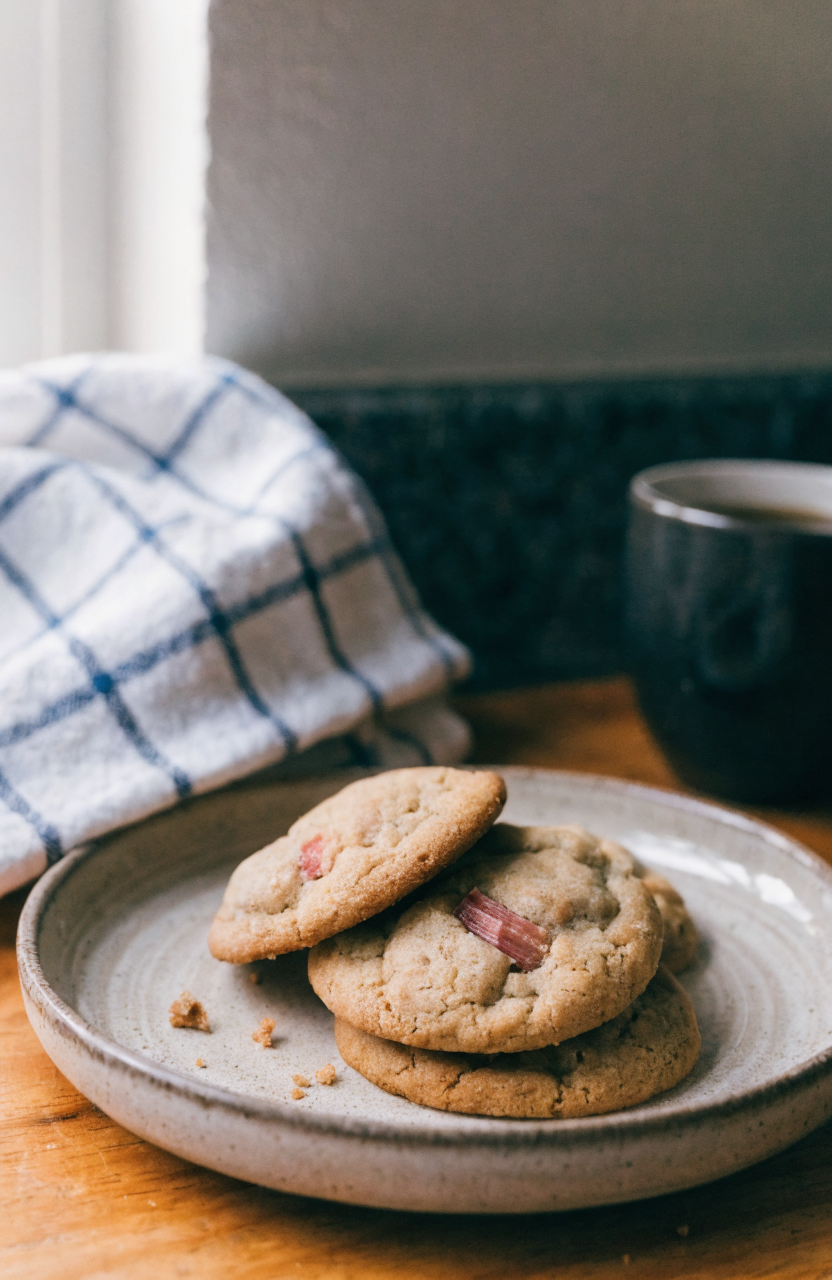
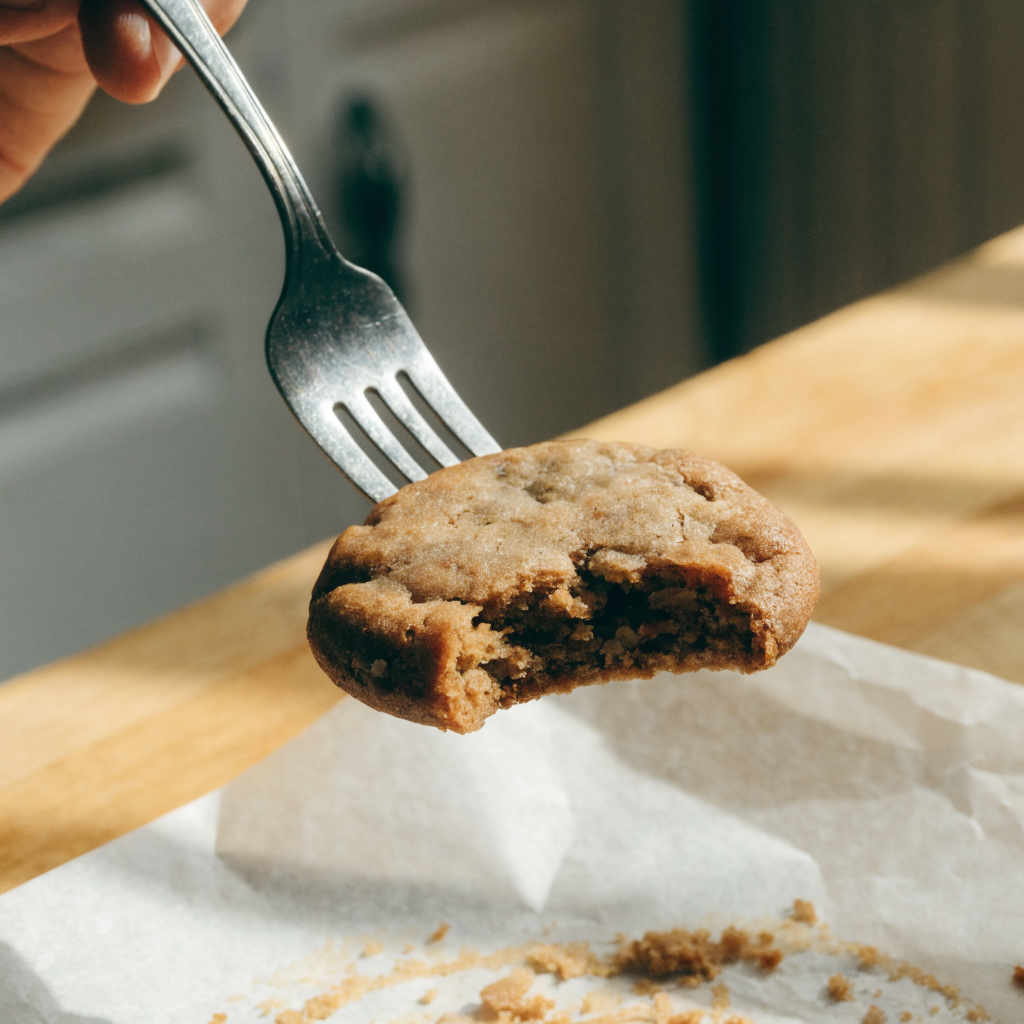
I remember the first time I tried brown sugar rhubarb cookies: the dough looked promising, but the pockets of raw-tasting rhubarb left the middle of several cookies doughy. After a few tests I settled on a simple fix—thinly slicing and lightly macerating the rhubarb, then folding it into a slightly drier dough and chilling briefly. The result is soft, chewy cookies with evenly distributed tangy bites; “brown sugar rhubarb cookies” show up in the first bite and in the aroma while they bake.
Why this brown sugar rhubarb cookies recipe works
The key technique that makes these brown sugar rhubarb cookies succeed is controlling rhubarb moisture and cookie spread. Rhubarb releases liquid as it sits and while baking; if you just chop and fold it into a standard soft-cookie dough you can end up with watery batter and underbaked centers. I macerate finely sliced rhubarb with a touch of sugar to draw off excess juice, then drain and pat it dry before folding it into a dough slightly lower in butter than a typical chewy cookie. That reduced fat, plus a short 15-minute chill, prevents over-spread while leaving the cookies tender.
Another important ratio is brown sugar to granulated sugar: brown sugar keeps the cookies moist and gives a caramel-like depth that complements rhubarb’s tartness. During testing I adjusted the flour and baking time so the edges set while the centers stay soft without being raw. The final method balances chew, flavor, and reliable bake time for busy home cooks who want a predictable result.
Key takeaways
- Slice rhubarb thinly and macerate briefly to remove excess moisture.
- Lower the butter slightly and chill the dough to prevent spread and sogginess.
- Brown sugar adds chew and caramel notes that pair with rhubarb’s tartness.
Ingredients you’ll need and what to substitute
You’ll need fresh rhubarb—about 1 cup sliced—which is the real star here. Frozen rhubarb can work in a pinch but must be fully thawed and very well drained; frozen tends to be softer so reduce maceration time. Use light brown sugar for a milder molasses note; dark brown sugar will make the cookies deeper and slightly more moist. I use a mix of all-purpose flour and a small amount of cornstarch (1 tablespoon) to give a tender crumb that still holds fruit pieces.
For butter, I use unsalted so I can control salt; if you use salted butter, skip or reduce added salt by 1/8 teaspoon. For an egg swap, one large egg is best—egg white-only makes them drier and yolk-only makes them richer and more fragile. Vanilla extract brightens the flavor; lemon zest (optional) is a great substitution for part of the vanilla if you want more citrus lift. If you want to cut sugar, reduce granulated sugar by up to 25%, but expect slightly less browning and chew.
Equipment
Essential tools are a medium mixing bowl, stand mixer or hand mixer (useful but optional), a rimmed baking sheet, parchment paper or silicone mat, and a cooling rack. A small bowl for macerating rhubarb and a kitchen scale or measuring cups are useful for accuracy. A 2-tablespoon cookie scoop keeps cookies uniform so they bake evenly.
How to make brown sugar rhubarb cookies
Prepare the rhubarb
Trim and thinly slice the rhubarb into 1/8- to 1/4-inch pieces; smaller pieces distribute more evenly and reduce wet spots. Toss the slices with 1 teaspoon of granulated sugar in a small bowl and let sit 10 minutes—this draws out some liquid. Then set the rhubarb in a fine-mesh sieve and press gently with the back of a spoon, or line a paper towel and pat dry. You should have mostly damp but not dripping pieces.
Make the cookie dough
Preheat the oven to 350°F with a rack in the center. In a bowl whisk together 2 cups all-purpose flour, 1 tablespoon cornstarch, 1 teaspoon baking soda, and 1/2 teaspoon fine salt. In a mixer or large bowl, cream 10 tablespoons (1 stick + 2 tablespoons) unsalted butter at room temperature with 1 cup packed light brown sugar and 1/4 cup granulated sugar until smooth and slightly fluffy, about 2 minutes. Scrape down the bowl, then beat in 1 large egg and 2 teaspoons vanilla extract until combined. With the mixer on low, add the dry ingredients just until combined; overmixing will toughen the cookies.
Fold and chill
Fold the drained rhubarb and 1/2 cup chopped toasted pecans or walnuts (optional) into the dough using a spatula. The dough will look slightly shaggy; refrigerate the dough for 15 minutes to firm the butter and reduce spread. This short chill is the part I added after early failures—longer chilling is fine but costs you time.
Portion and bake
Line two rimmed baking sheets with parchment. Use a 2-tablespoon scoop and place dough balls 2 inches apart. If you like a slightly crinkled top, gently press down a hair with the scoop or your fingertips. Bake one sheet at a time for 10–12 minutes, until the edges are set and light golden while the centers still look soft. Rotate the sheet halfway through baking for even color. Let the cookies cool on the sheet for 5 minutes (they finish setting), then transfer to a rack to cool fully.
Things I learned the hard way
- Don’t skip the maceration: early batches with raw-chopped rhubarb had undercooked pockets. A 10-minute maceration plus pat-dry avoids that.
- Too much butter leads to flat, greasy cookies. Reducing butter by 1–2 tablespoons fixed spread without making the cookies dry.
- Chunky rhubarb pieces cause uneven baking; slice thin for uniform texture.
- Chill the dough at least 15 minutes—anything less and the cookies flatten too much.
- If using frozen rhubarb, thaw completely and squeeze out as much moisture as possible before adding; expect a slightly longer bake.
- My first attempt used dark brown sugar only; the cookies tasted lovely but were wetter. Mixing light brown with a little granulated sugar yields better structure.
Variations to try
- Oat and Rhubarb: Replace 1/2 cup flour with 1/2 cup old-fashioned oats for chew and a heartier texture; add 1 extra minute to the bake time.
- Lemon-Rhubarb: Add 1 tablespoon lemon zest and reduce vanilla to 1 teaspoon for brighter flavor; no timing change.
- White Chocolate: Fold in 3/4 cup white chocolate chips instead of nuts; reduce granulated sugar by 2 tablespoons if you prefer less sweet.
- Gluten-Free: Use a 1:1 gluten-free flour blend and add 1/4 teaspoon xanthan gum if your blend lacks it; watch bake time—it may need an extra 1–2 minutes.
Storage, freezing, and reheating
Store cooled cookies in an airtight container at room temperature for up to 3 days; layering with parchment helps prevent sticking. For longer storage, freeze baked cookies in a freezer-safe container for up to 3 months—separate layers with parchment. Thaw at room temperature for 30–60 minutes, or warm in a 325°F oven for 5–7 minutes to refresh texture. You can also freeze scooped dough balls on a tray until solid, then transfer to a bag; bake frozen dough at 360°F for 12–15 minutes, adding 2–3 minutes to the bake time and checking for set edges.
What to serve with brown sugar rhubarb cookies
These cookies pair well with a mug of coffee or a cup of strong black tea for breakfast or an afternoon snack. For a dessert plate, serve with plain yogurt or ricotta sweetened lightly with honey to balance the tartness. They also travel well in a lunchbox alongside apple slices or a small container of cottage cheese.
Brown Sugar Rhubarb Cookies
Ingredients
Equipment
Method
- Trim and thinly slice rhubarb into 1/8–1/4-inch pieces, toss with 1 teaspoon granulated sugar and let sit 10 minutes, then drain in a fine-mesh sieve and pat dry with paper towels.
- Whisk together flour, cornstarch, baking soda, and salt in a medium bowl.
- Cream butter with brown sugar and granulated sugar until smooth, about 2 minutes; beat in egg and vanilla until combined.
- Mix dry ingredients into the butter mixture on low speed just until combined, then fold in drained rhubarb and nuts or chips if using.
- Chill the dough in the refrigerator 15 minutes to firm slightly.
- Preheat oven to 350°F and line baking sheet with parchment. Scoop 2-tablespoon balls of dough 2 inches apart, bake 10–12 minutes until edges are set and lightly golden, rotate sheet halfway through baking.
- Let cookies cool on the baking sheet 5 minutes, then transfer to a wire rack to cool completely.
Notes
Frequently asked questions
Can I use frozen rhubarb? Yes—thaw it completely and press out excess moisture, then proceed with the maceration briefly; expect a slightly softer texture and possibly a couple extra bake minutes.
Why are my cookie centers raw? Raw centers usually come from oversized rhubarb pieces or underbaked dough. Use small slices and ensure the edges are golden and the centers look just set before removing from the oven; they finish on the hot sheet for 5 minutes.
Can I make these nut-free? Yes—omit nuts or replace them with 1/2 cup rolled oats or extra white chocolate chips if desired.
Do I need to chill the dough overnight? No—this recipe requires only a 15-minute chill. Overnight chilling is fine and may deepen flavor, but 15 minutes is enough to control spread for most kitchens.
How long do they keep? At room temperature in an airtight container they stay good for up to 3 days. For longer storage freeze baked cookies up to 3 months.
Closing
These brown sugar rhubarb cookies are an everyday recipe you can rely on—soft, chewy, and studded with bright rhubarb bites—thanks to the small steps that tame excess moisture. I’ll usually make a double batch when rhubarb is in season so there’s a stash for coffee breaks and lunchboxes.

Leave a Reply